
OMIS - PT Progress
OMIS - PT Progress is a web application that is used to manage operational management information systems at PT Progress. This application is used by the company to manage operational management information systems at PT Progress. This application is also used to monitor the performance of the company in managing operational management information systems at PT Progress.
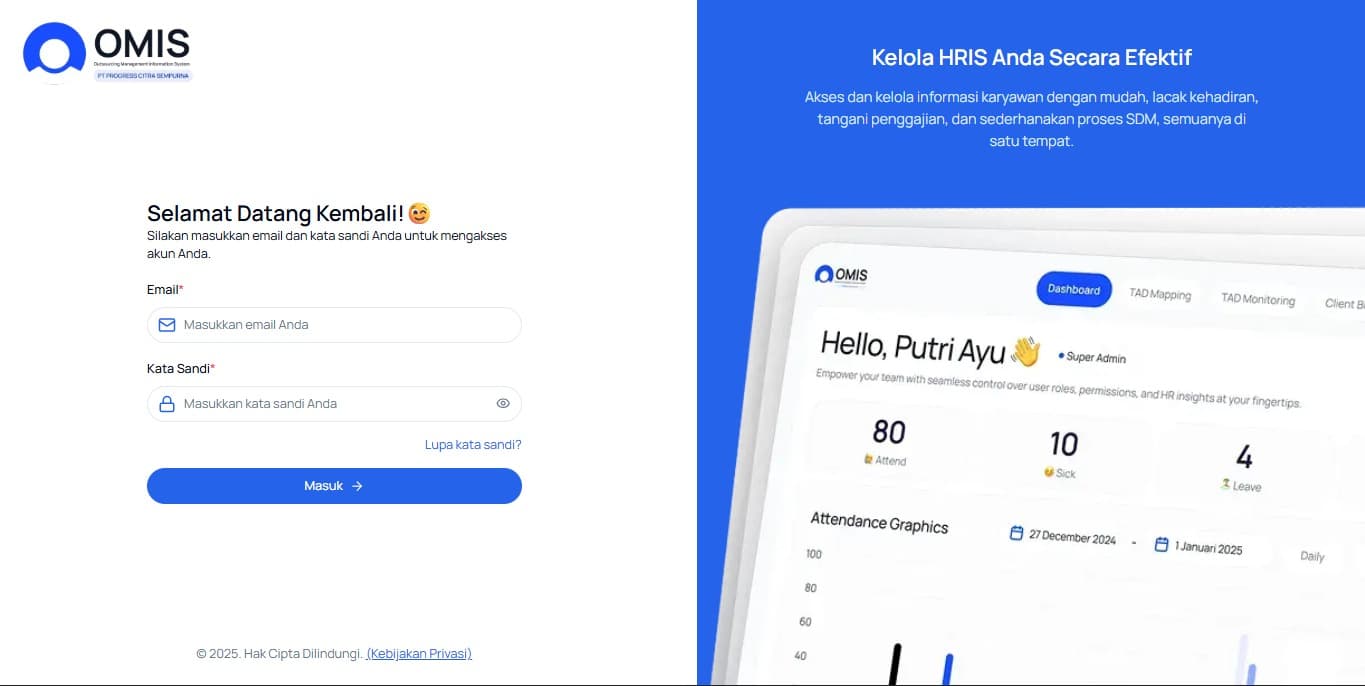
Summary: This project is the frontend for an Outsourcing Management Information System (OMIS), built with Next.js 15 and the App Router. It provides a feature-rich interface for HR administrators and managers to handle talent mapping, client billing, compensation claims, and user permissions. The application is designed as a secure, performant, and scalable client that interacts with a separate backend API for all business logic.
Business Flow
- An administrator or manager logs into the system.
- The user accesses a role-based dashboard with relevant menus (e.g., User Management, Master Data).
- Admins manage core data like clients, employee records, and system users.
- Managers use "Talent Mapping" and "Talent Monitoring" to analyze workforce assignments.
- Employees can submit requests via modules like "Claim Compensation".
- The system provides logs for auditing and features for data backup.
Key Features
- User & Role Management — core
- Talent Mapping & Monitoring — core
- Claim & Compensation Management — core
- Client Billing & Payment History — core
- Master Data Management — core
- System Activity Logging — core
- Data Backup & Restore — optional
Tech Stack
- Frontend: Next.js 15, React 19, TypeScript, Tailwind CSS, ShadcnUI, TanStack Query, Zustand
- Backend: Node.js (via Next.js server); connects to an external REST API for business logic.
- Data/DB: Handled by the external backend API.
- AI/ML: Not applicable.
- DevOps/Infra: Docker, Nginx (from docs), Kubernetes (from docs), Husky, ESLint, Prettier, Jest
- Integrations: External REST API (assumed), anaratech.com (for image storage).
Architecture (short)
- Style: hybrid
- Components: Monolithic Frontend (Next.js), Client-Server pattern, TanStack Query (for server state caching), Zustand (for global client state), Centralized Axios instance with security interceptors, Component-based UI (ShadcnUI), Role-based access control (RBAC).
How to Run (dev) npm install && npm run dev
Differentiators
- Modern, type-safe stack using Next.js 15 (App Router) and React 19.
- Robust data fetching and state management with TanStack Query and Zustand.
- Strong focus on code quality with linting, formatting, and conventional commit hooks.
- Container-ready with a provided Dockerfile for consistent deployments.
- Security-conscious design with data sanitization and strict HTTP security headers.
Limitations & Next Steps
- The application is a frontend client and requires the corresponding backend API to be fully functional.
- Test coverage with Jest exists but could be expanded for more comprehensive validation.
- A formal CI/CD pipeline is not defined within the repository.
- Accessibility (a11y) could be formally audited and improved.